
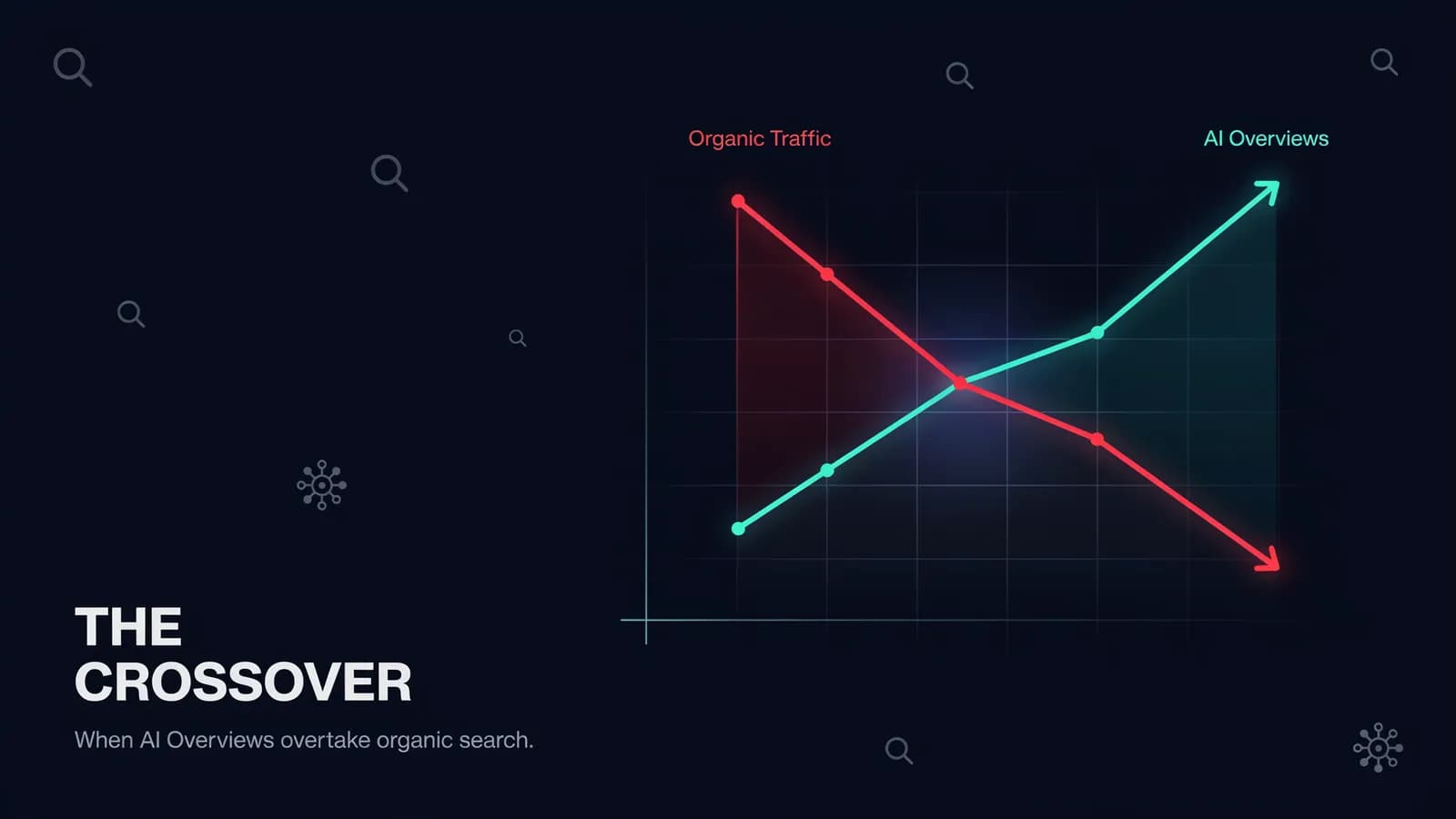
Your Google impressions are up. Your organic traffic is down. Both are true — and that contradiction is not a reporting glitch. The gap between what Google shows and what actually clicks through is growing every quarter, and there's a name for it now: the Great Decoupling. Clearscope called it bluntly: your organic traffic isn't coming back — not because your content got worse, but because the page it lived on changed around it. Only 276 out of every 1,000 Google searches now send a visitor to any website at all. If you're managing a channel that depends on organic traffic, you already feel the pressure. The question is whether the playbook you're running today was designed for this search environment — or the one from two years ago.
Something quietly changed in your Google Search Console data — and it probably happened before you noticed. Your ranked pages are still ranking. Impressions may even be climbing. But the traffic that used to follow those rankings has gone somewhere else. Not to a competitor's site. Not to a social platform. Nowhere you can track. This is what happens when Google starts answering questions before anyone clicks — and it's happening to far more of your queries than your analytics would suggest. The content strategy that's been working for three years may now be optimized for a search result page that no longer exists.
The Data: What's Actually Happening to Organic Traffic
The numbers published this year are stark enough that they're worth quoting directly rather than summarizing.
In June 2026, SparkToro and Similarweb released the most comprehensive zero-click study to date, covering January through April 2026. The headline: 68.01% of US Google searches now end without a single click to any external website. That's up from 60.45% in 2024 — a rise of 7.56 percentage points in two years, which the researchers called the fastest acceleration on record.
Translated out of percentages: only 276 out of every 1,000 Google searches currently reach the open web. In 2024, that number was 374. You're losing nearly 100 potential visitors per 1,000 searches compared to two years ago — and that loss is accelerating, not stabilizing.

The device split makes it worse. On mobile — which accounts for over 60% of all Google searches — zero-click rates hit 77.2%. Desktop sits at 46.5–50.6%. The aggregate 68% figure actually understates mobile reality.
These are search-level numbers. At the content level, the picture is just as clear. Seer Interactive analyzed 25.1 million organic impressions across 42 organizations, tracking 3,119 informational queries between June 2024 and September 2025. Their findings:
- Organic CTR dropped 61% when an AI Overview was present (from 1.76% to 0.61%)
- Paid CTR dropped 68% when AI Overviews appeared
- Organic CTR on queries without AI Overviews dropped 41% year-over-year
That last number is the one worth pausing on. Even queries where Google didn't add an AI summary saw a 41% CTR decline. This suggests behavioral change is happening independently of any specific SERP feature — users are simply clicking less.
Ahrefs tracked 300,000+ informational keywords and found that position-1 organic CTR drops 58% when an AI Overview is present. That's up from 34.5% in April 2025. In eight months, the CTR hit from AI Overviews nearly doubled.
Pew Research Center tracked 68,000 real Google searches and reached a similar conclusion: AI summaries cut click-through by 46.7%, with CTR dropping from 15% to 8% — nearly halved.
Gartner's forecast from 2025 projects a 25% drop in traditional search volume by 2026 compared to prior baseline. Their reasoning isn't that people are searching less — it's that more searches are being resolved inside AI interfaces before users ever reach a results page.
Why This Drop Is Structural, Not Seasonal
This is not a Google algorithm update. It is not a content quality issue. And it is not a dip that will correct itself when the market settles.
The mechanism is straightforward: Google has shifted from being a search engine — a system that finds pages — to being an answer engine — a system that provides answers. AI Overviews are the most visible symptom, but the shift runs deeper than a single feature.
When Google synthesizes your content into an AI Overview, it counts that appearance as an impression in Search Console. Your rankings look stable or even improved. But the user received the answer without clicking. From Google's perspective, the search was successful. From your perspective, the visitor never arrived.
This is what Ahrefs named the Great Decoupling in June 2025: the historic correlation between search rankings and organic traffic is breaking down. Impressions climb. Clicks don't follow. The relationship that made SEO worth investing in — rank higher, get more traffic — is no longer reliable for informational content.
Moz confirmed the pattern in their 2026 SEO Trends analysis, and Grow&Convert documented it across 20+ client accounts in February 2026: "more rankings, less traffic" is now the normal outcome for informational content, not an anomaly.
And there's a next wave coming. Google's AI Mode — a fully AI-generated search experience separate from standard results — currently shows a 93% zero-click rate according to Semrush's 2025-2026 analysis. If AI Mode becomes the default search experience for logged-in users, which Google's roadmap suggests is directional, the 68% zero-click rate we see today would look modest.
HubSpot — the largest single content marketing brand with a public earnings report — named AI Overviews directly as the cause of a 70–80% decline in organic traffic on their 2025 earnings call. If that's what's happening to a domain with HubSpot's authority and content depth, this is a structural shift, not an execution problem.
Who Gets Hit Hardest (and by How Much)
Not all content is equally exposed. The risk is concentrated — and the research is specific enough that you can estimate your own exposure.
By query intent (Semrush Intent Study):
Content Type | Zero-Click Rate |
|---|---|
Informational queries | 74% |
Navigational queries | 68% |
Commercial investigation | 46–51% |
Transactional queries | 31–39% |
If your content strategy is built around informational queries — "what is," "how does," "why does" — you're operating in the 74% zero-click territory. That's the category where Google's AI is most capable and most motivated to answer in-SERP.
By content type:
- Definition and "what is" pages: Up to 50% traffic loss — the highest-risk format. These pages existed to answer a question. AI Overviews answer it better, instantly, without a click.
- Publisher and media sites: Google referral traffic down ~38% year-over-year (Press Gazette / Chartbeat, 2025).
- B2B informational content: Average 34% traffic loss in 2024–2025 (Onely/BrightEdge), with some niches losing up to 70%.
- Non-branded informational queries: Amsive's 700,000-keyword analysis found a 19.98% CTR decline specifically for non-branded informational content.
The pattern is consistent: the more your content answers a general knowledge question, the more vulnerable it is. Whether informational content is still worth creating — and under what conditions — is a question worth examining with your current traffic mix in mind.
The Safe Harbors: What's Actually Surviving
Not everything is declining. The same research that shows informational content collapsing shows commercial content holding.
Transactional queries have a 31–39% zero-click rate — meaning 61–69% still produce clicks. Google is not yet trying to complete purchases inside the SERP. Commercial investigation content — comparison pages, alternatives roundups, buying guides — sits at 46–51% zero-click, still meaningfully better than informational.
Amsive found something specific: while non-branded informational CTR dropped nearly 20%, branded queries showed a slight increase in CTR. When someone searches for your company or product by name, they still click. Brand recognition is becoming a traffic moat in a way it wasn't three years ago.
Brands cited in AI Overviews also show a compounding benefit: Seer Interactive's 2026 analysis found that brands mentioned in AI Overviews earned 35% more organic clicks and 91% more paid clicks than uncited competitors. The mechanism isn't the click inside the AIO itself — Pew Research found that only 1% of clicks within an AI Overview go to cited sources. The benefit is brand recall and intent that materializes in later branded searches.
Original research, unique datasets, and first-party findings are also holding. AI Overviews summarize what's available — they can't summarize what doesn't exist anywhere else. If your content contains data points that no other source has, it can't be fully synthesized away.
The New Traffic Math: Impressions + Citations
Your analytics need to change before your strategy can.
The old framework: rank on page one → receive traffic proportional to position. That relationship is broken for informational content. The new framework requires measuring two separate things that your current tools probably aren't showing you together.
Signal 1: The decoupling ratio. For each query where you have impressions in Google Search Console, compare impressions to clicks over time. If impressions are stable or rising while clicks decline — that query is decoupling. This is not an aggregate number you need; it's a query-by-query signal that tells you exactly where Google is intercepting your traffic before it arrives.
Signal 2: AI citation presence. Being cited in an AI Overview, a ChatGPT answer, or a Perplexity response is now a distinct visibility signal from a ranking. A page can rank #4 and be cited in the AI Overview at position #1. A page can rank #1 and be invisible in AI responses. These are two separate questions: "Do I rank?" and "Do AI systems cite me?" Right now, most marketing teams have an answer to the first question and no answer to the second.
Citation click-through rates in AI-native search engines — where the user specifically went to get an AI answer — are significantly higher than within Google's SERP. ChatGPT Search citations produce an 18% CTR; Perplexity citations produce 7% (Digital Applied, Q1 2026). These are high-intent users making a deliberate query.
Understanding your LLM tracking tools options is the starting point for measuring this second signal.
4 Strategic Moves That Work in the Post-Traffic Era
The strategic response to the Great Decoupling is not to abandon SEO. It's to rebuild it around what actually still converts.
1. Shift your content mix toward commercial intent.
Informational content is not worthless — it builds topical authority and feeds AI citation. But if your traffic goals depend on informational content generating visits, the math has changed. Commercial investigation content (comparisons, alternatives, buying guides, reviews) produces 2–3x the clicks per impression compared to informational queries. This shift doesn't require abandoning your topic coverage — it requires being honest about what your informational content is optimized for.
Thinking through your SEO vs AEO strategy helps clarify where your current content mix sits and what a rebalanced portfolio looks like.
2. Optimize your content for AI citation, not just ranking.
Being cited in an AI Overview requires different optimization than ranking in organic results. AI systems favor:
- Specific, quotable claims (not vague assertions)
- First-party data and original research
- Direct answers in the first paragraph, not buried at the end
- Structured content with clear headings that can be extracted in fragments
- Authorship signals (byline, expertise, publication date)
Think of AI citation optimization as answer-layer SEO. Your page needs to be the best single source for a specific factual claim, not just a broadly relevant resource on a topic.
3. Build branded search volume.
When branded CTR is holding while non-branded CTR collapses, brand building becomes a traffic strategy. Every AI citation that mentions your company by name — even without a click — contributes to branded searches that do convert. Email newsletters, social distribution, and PR all now have a direct traffic-maintenance function that didn't exist when organic informational content was reliably converting.
4. Reduce single-channel dependency.
Any traffic channel where a third-party platform controls the distribution is a risk. Organic search via Google was the dominant channel for most content-led companies — and that channel just had its most disrupted two years since mobile. Building owned audiences (email, community, direct subscription) is the infrastructure investment that makes every other channel more resilient.
How to Track Both Organic and AI Visibility in One Place
The measurement gap is where most teams are currently losing the most ground. They know their organic traffic is declining. They don't know which specific queries are decoupling. And they have no visibility into whether AI systems are citing them at all.
The correct dashboard for this environment shows two things side by side: GSC organic data (impressions, clicks, CTR, position — by query, not aggregate) and AI citation presence (whether your domain appears in Google AI Overviews, ChatGPT, Perplexity, and other AI-native surfaces).
When you can see both columns together, you can answer the questions that actually matter in 2026:
- Which of my ranked queries are decoupling (impressions up, clicks down)?
- For those decoupling queries, am I being cited in the AI Overview that replaced my click?
- Which queries am I cited in AI responses but not currently ranking for — where citation is driving brand recall without a direct click?
- Where are AI systems citing competitors and not me — and what does their content have that mine doesn't?
Allable connects GSC organic signals with AI citation tracking in one platform, so you can see the decoupling pattern at the query level and identify which content is being cited versus which content is being bypassed. The ChatGPT visibility tracking use case is one specific area where this matters — knowing whether your brand appears in AI-generated answers for high-intent queries.
The Content Strategy Reset: What to Stop, Keep, and Add
Based on the data above, here's a concrete framework for auditing your current content strategy.
Stop (or radically reduce):
- Publishing generic "what is" and definition pages without original data or a unique perspective
- Measuring content success by sessions or pageviews alone — a page being cited in AI responses while generating fewer clicks is succeeding by a different metric
- Treating search rankings as a proxy for visibility — a page can rank and be invisible to AI systems, or be uncited and still rank
Keep (and protect):
- Content with original research, proprietary data, or first-party case studies — this is the category least vulnerable to AI summarization
- Commercial investigation content (comparisons, alternatives, pricing breakdowns) — still drives clicks at meaningful rates
- Branded content — anything that builds the association between your company name and a specific problem or outcome
Add (if not already doing):
- Query-level decoupling monitoring: GSC impressions vs. clicks tracked over time per keyword, not just aggregate channel traffic
- AI citation tracking: know which AI surfaces are mentioning you and for which queries
- Brand search volume tracking: as a leading indicator of whether your content and visibility strategy is building recognition
- Content that directly targets whether informational content is still worth creating — because your team is likely having that internal debate right now
Frequently Asked Questions
- Is organic traffic dead?
- No — but informational organic traffic has structurally declined for most sites, and that decline is accelerating. The 276/1,000 searches that still reach the open web represent real traffic. Commercial, branded, and research-backed content is still generating meaningful visits. What's changed is that the informational content volume play — publish at scale, rank for every question in your niche, capture passive traffic — produces significantly less return than it did two years ago.
- Will Google reverse AI Overviews?
- Unlikely. Google's AI Overview rollout accelerated in March 2025, expanding coverage by 116%. Their product roadmap points toward AI Mode — a fully AI-generated interface — becoming standard. The ad revenue pressure from zero-click results creates internal tension at Google, but there is no evidence of a rollback. The more useful question is whether your content strategy accounts for a world where AI Overviews are present in 40–60% of your target queries.
- How do I know if AI is actually cannibalizing my traffic?
- The signal is in your Search Console data. Pull impressions and clicks by query over the last 12 months and look for queries where impressions are flat or rising while clicks are falling. That pattern — the decoupling signature — identifies exactly where AI Overviews are intercepting your traffic. A secondary signal: cross-reference those queries against AI citation data to see whether you appear in the AI Overview for those terms. If you rank but are uncited in the AIO, the traffic hit is direct and uncompensated. If you rank and are cited, the click loss is partially offset by brand recall from the citation.
- Does being cited in an AI Overview actually help?
- It helps — but not in the way most teams assume. Only 1% of clicks within an AI Overview go to cited sources directly (Pew Research, 2026). The click-through from the AIO citation itself is minimal. The benefit is downstream: Seer Interactive found that brands cited in AI Overviews saw 35% more organic clicks and 91% more paid clicks versus uncited competitors. The mechanism is brand recall — users who see your brand name in an AI answer are more likely to search for you by name later, and those branded searches convert at high rates.
- What content formats are safest right now?
- Transactional content (product pages, pricing comparisons, direct offers) has the lowest zero-click rate at 31–39% — more than 60% of those searches still produce a click. Commercial investigation content (alternatives roundups, head-to-head comparisons, in-depth reviews) follows at 46–51% zero-click. First-party research and original data are the most citation-friendly formats across both Google AI and LLM-native search. The highest-risk formats are pure informational content ("what is," "how does," "benefits of") which runs at 74% zero-click in current studies.
What Happens If You Don't Change the Measurement Model
You can keep publishing at the same rate and measuring traffic at the channel level — and your reporting will look acceptable for another 6–12 months while the underlying audience relationship erodes. The aggregate organic channel number is a lagging indicator. The teams who are ahead of this are measuring at the query level — watching which specific terms are decoupling, tracking whether they appear in AI responses, and rebalancing toward formats that still generate direct clicks. If you want to see where your content actually stands in 2026 — which queries are decoupling, where AI is citing you, and where it isn't — Allable tracks both GSC organic signals and AI citation presence in one place.