
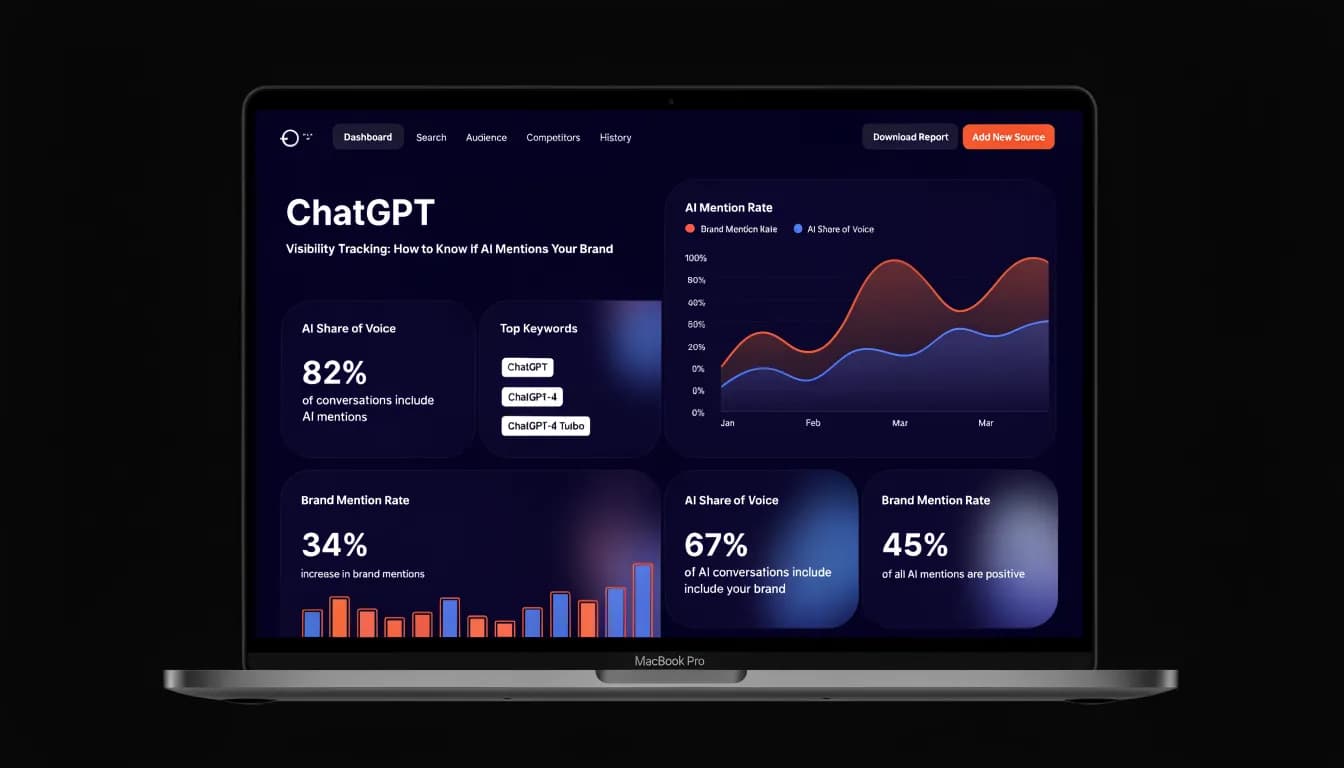
Your brand shows up in ChatGPT answers — or it doesn't. Either way, your analytics won't tell you. That gap is costing you leads you never knew existed.
Right now, ChatGPT's 600 million weekly active users (OpenAI, May 2026) are asking which tools to use, which vendors to trust, and which products to buy. ChatGPT answers them. It mentions some brands. It ignores others. It sometimes gets things wrong. And unless you have a system to monitor this, you have no idea which category your brand falls into.
Your Google Search Console shows clicks and impressions. Your GA4 shows sessions and conversions. Neither of them tracks whether ChatGPT recommended your competitor instead of you to 50,000 potential customers this month. That data just disappears.
What's interesting isn't that this tracking gap exists -- it's how few marketing teams have noticed it. The shift from search clicks to AI-generated answers has been gradual enough that most analytics dashboards never caught up. The question isn't whether ChatGPT visibility matters for your pipeline. It's whether you can afford to keep flying blind while your competitors figure it out first.
What ChatGPT Visibility Actually Measures
ChatGPT visibility tracking is not about ranking. There are no positions, no page-one placements, no ranking factors in the traditional sense.
What you're measuring is something different: mention frequency. How often does ChatGPT include your brand, product, or content in its answers to relevant queries? And when it does mention you, how does it describe you?
There are three dimensions that matter:
1. Mention rate -- Out of all relevant queries in your category, what percentage of ChatGPT responses include your brand? If you sell project management software and ChatGPT answers 1,000 questions about project management tools per day, how many of those answers mention your product?
2. Sentiment and framing -- ChatGPT doesn't just list brands. It describes them. It might call your product "ideal for small teams" or "better suited for enterprise." That framing influences buying decisions. Tracking sentiment means knowing how ChatGPT characterizes your brand, not just whether it mentions you.
3. Share of voice vs competitors -- This is arguably the most actionable metric. If ChatGPT mentions Competitor A in 45% of category answers and you appear in 12%, that gap is measurable and, more importantly, closeable.
None of this shows up in traditional analytics. A buyer who asked ChatGPT "what's the best SEO platform for agencies?" and got three recommendations -- none of which were you -- never generated a bounce rate, a session, or a missed conversion in your data. They just never showed up.
Why Your Current Analytics Miss ChatGPT Entirely
Google Analytics, Search Console, and most attribution tools measure behavior that happens in your own domain or through trackable referrals. ChatGPT responses are neither.
When ChatGPT answers a question, a few things can happen:
- The user follows a cited link -- this might generate a referral visit, often misattributed or labeled "direct"
- The user acts on the recommendation without clicking anything -- zero trace in your analytics
- The user asks follow-up questions in the same ChatGPT session -- still zero trace
- ChatGPT provides a wrong or outdated description of your product -- you have no way to know
The third scenario is more common than most brands realize. ChatGPT's knowledge has training cutoffs, and product features change. Your pricing might have changed. Your positioning might have evolved. If ChatGPT is telling potential buyers something inaccurate about your product, you won't see it in any dashboard -- unless you're actively monitoring.
The referral traffic argument is also misleading. Some brands point to a spike in "direct" traffic or "chatgpt.com" referrals as proof that ChatGPT is sending them buyers. But this only captures users who clicked a link in ChatGPT's response. The majority of buying decisions influenced by ChatGPT happen before any click. The influence is invisible.
This is the structural gap that ChatGPT visibility tracking addresses.
How to Track ChatGPT Visibility: 3 Practical Methods

You have three options, each with different tradeoffs on effort, depth, and cost.
Method 1: Manual Prompt Monitoring
The simplest starting point. You write a set of queries that represent how your potential buyers search -- "best [category] tools," "alternatives to [competitor]," "[use case] software for [persona]" -- and you run them through ChatGPT manually on a regular schedule.
You document:
- Was your brand mentioned?
- What was said about it?
- Which competitors were mentioned?
- In what order were brands listed?
This approach costs nothing and gives you real qualitative signal. Its weakness is scale. You can realistically monitor 20-30 prompts per session. Your actual target query universe is probably thousands of variations. And doing this manually every week is the kind of task that gets deprioritized the moment something more urgent appears.
Manual monitoring is a valid starting point. It shouldn't be your endpoint.
Method 2: Automated Tracking with Specialized AI Visibility Tools
This is where the category has matured significantly over the past 12 months. Several platforms now query ChatGPT (and other LLMs) programmatically at scale, track brand mentions, score sentiment, and report on share of voice over time.
You define your tracked keywords and competitors, the tool runs hundreds or thousands of queries on a schedule, and you get a dashboard showing your visibility trends. This is the only realistic way to track ChatGPT visibility across your full query universe.
We'll cover the main tools in the next section.
Method 3: Citation and Source Monitoring
When ChatGPT Plus users have browsing enabled, or when Perplexity and similar tools cite sources, you can sometimes see which pages are being referenced. Monitoring your inbound links and referral traffic from AI search surfaces gives you a partial picture.
Tools like Ahrefs and Semrush have begun tracking AI-generated traffic separately. Some brands use web analytics segments to isolate "AI referral" sessions. This method is complementary, not standalone -- it only captures the fraction of AI-influenced traffic that generates a click.
The most complete picture comes from combining all three: manual audits for qualitative depth, automated tracking for scale and trend data, and citation monitoring for the link-level signal.
The Best Tools for ChatGPT Visibility Tracking
The tooling landscape here is young and moving fast. These are the platforms that have established actual product-market fit as of mid-2026.
Profound
Profound is the enterprise-grade option. It tracks brand mentions across ChatGPT, Perplexity, Gemini, and Copilot at scale, with deep reporting on sentiment, competitive share of voice, and citation source attribution. It integrates with Slack and major BI tools.
The tradeoff is price and complexity. Profound is built for larger marketing teams with dedicated analysts and the budget to match -- plans start well above $1,000/month. If you're a mid-market company looking to get started with AI visibility monitoring, the ROI calculation needs careful thought.
Best for: Enterprise brands with complex multi-LLM monitoring needs.
Otterly.ai
Otterly positions itself as the accessible option for mid-market brands. It monitors brand mentions across ChatGPT and Perplexity, tracks competitor visibility, and surfaces sentiment analysis in a cleaner UI than most enterprise tools.
Starting around $99/month, it's more accessible. The query coverage isn't as deep as Profound, and the reporting is less customizable, but for teams that need to answer "is our brand showing up in AI search?" without a six-figure budget, it's a credible starting point.
Best for: Marketing managers who need clear, actionable AI visibility data at a reasonable cost.
Semrush AI Toolkit
If you're already a Semrush subscriber, the AI visibility features are worth exploring. Semrush has integrated AI overview tracking and LLM mention monitoring into its broader SEO platform, allowing you to see AI search data alongside traditional SERP data in the same interface.
The limitation is that it's tightly coupled to the Semrush ecosystem. If you're not using Semrush for SEO, adding it just for AI tracking is a significant investment for a feature set that isn't its core strength.
Best for: Teams already embedded in the Semrush ecosystem who want to add AI visibility data without a new tool.
Allable.ai
Allable.ai includes AI search visibility monitoring as part of its all-in-one marketing platform -- alongside SEO tools, content creation, campaign management, and analytics. The AI visibility module lets you track brand mentions across ChatGPT and other LLMs, monitor competitor share of voice, and see sentiment trends, all from the same dashboard you're already using for SEO and content work.
The positioning is different from standalone AI visibility tools. Instead of a separate tool for each marketing function -- one for SEO, one for content, one for AI visibility -- Allable consolidates the data into a single workspace. You see how your AI visibility correlates with your organic rankings and content performance, not in isolation.
Pricing: Free forever plan | Pro: 31 EUR/month | Business: 91 EUR/month.
Best for: Marketing teams looking for unified AI + SEO visibility without managing multiple vendor relationships.
Which Metrics Actually Tell You Something Useful

Not all visibility data is actionable. Here's what to focus on:
Brand mention rate by query cluster -- Don't look at overall mention rate in isolation. Segment your tracked queries by intent (awareness, consideration, decision) and by product category. Your mention rate in "best [category] tools" queries matters differently than your mention rate in "[your brand name] reviews."
Mention rate trend over time -- A single measurement tells you where you stand. A trend tells you whether the actions you're taking are working. Track weekly or monthly, and correlate changes with content you've published or earned coverage you've secured.
Competitive share of voice -- Which competitors are appearing alongside you? Which are appearing instead of you? If a competitor's mention rate jumped from 18% to 34% in your category over two months, that's a signal worth investigating -- what did they publish, earn, or change?
Sentiment and framing accuracy -- Is what ChatGPT says about your product accurate? Does it reflect your current positioning, pricing, and feature set? Inaccurate AI descriptions are a conversion killer that never shows up in your funnel data.
Citation frequency -- When ChatGPT does cite sources, are your pages being referenced? A high mention rate with low citation frequency suggests ChatGPT has absorbed brand knowledge from elsewhere (training data, secondary sources) rather than from your own content. Citation frequency is a proxy for how well your own content is feeding the model.
How to Use Visibility Data to Get Mentioned More
Tracking is only valuable if you act on the data. Here's what actually moves the needle on ChatGPT visibility:
Publish authoritative, structured content on category-defining topics. ChatGPT tends to mention brands that appear authoritative in their category. This means comprehensive guides, original research, and well-structured comparison content -- not thin landing pages. If you don't have a definitive resource on the core problem your product solves, that's the starting gap. For the broader picture of how AI is changing marketing strategy, see AI enablement for marketing teams.
Earn mentions in sources ChatGPT trusts. Publications that ChatGPT was trained on -- large industry publications, trusted review platforms, established blogs -- act as signal sources. Getting mentioned in G2, Capterra, Product Hunt, and category-specific media teaches the model that your brand belongs in this conversation.
Fix inaccuracies proactively. If your ChatGPT monitoring reveals that the AI is describing your product incorrectly -- wrong pricing, outdated features, mischaracterized use cases -- publish clear, accurate, authoritative content that addresses those specific points. This is slower than you'd like, but it works over time. Pairing this with strong technical SEO fundamentals helps -- a solid guide to AI SEO tools covers the foundational stack.
Build entity clarity. ChatGPT handles named entities better when they're unambiguous. This means your brand name, product name, and category positioning should be consistent across your website, your PR, your reviews, and your content. Ambiguity in how you describe yourself creates ambiguity in how ChatGPT describes you.
Track the full loop. Set a 90-day measurement cadence. Publish content, monitor AI visibility, adjust, repeat. This is what turns visibility tracking from a reporting exercise into an actual acquisition channel.
Frequently Asked Questions
Can I track ChatGPT visibility for free?
You can start manually with zero cost -- write a set of test prompts and run them through ChatGPT yourself. For scale and trend data, free tiers on most tools are limited. Allable.ai offers a free plan that includes basic AI visibility features. For serious monitoring across hundreds of queries, expect to pay for a dedicated AI visibility tool.
Does ChatGPT show referral traffic in Google Analytics?
Occasionally. When a user with a ChatGPT Plus subscription clicks a cited link, it may appear as a referral from chatgpt.com in your analytics. But the majority of ChatGPT-influenced decisions happen before any click -- the referral traffic data is a fraction of the actual influence. Don't use it as your primary measurement.
How often should I check my ChatGPT visibility?
Weekly tracking is the right cadence for most marketing teams. Daily is excessive unless you're in a fast-moving category or running active experiments. Monthly is too infrequent to catch changes that might affect your pipeline. Automated tools handle this without manual effort -- you review a dashboard, not individual queries.
Does publishing more content improve ChatGPT visibility?
Publishing more content does not automatically improve visibility. What matters is publishing authoritative, accurate, well-structured content on topics relevant to your category -- and earning coverage from sources ChatGPT trusts. Thin content at high volume is counterproductive.
What is an AI visibility checker?
An AI visibility checker is a tool that queries one or more large language models (ChatGPT, Perplexity, Gemini, Claude) with prompts relevant to your brand category and measures how often, and how positively, your brand appears in the responses. Think of it as a brand monitoring tool specifically built for AI-generated answers rather than web mentions. Most AI visibility tools include a checker as their core feature.
Is ChatGPT visibility the same as AI Overview visibility on Google?
No. Google's AI Overviews (formerly SGE) and ChatGPT answer differently, draw from different sources, and require separate tracking approaches. A brand that appears in Google AI Overviews may not appear in ChatGPT responses, and vice versa. If you're tracking AI visibility seriously, you should monitor both surfaces.
How do I know if ChatGPT is describing my brand accurately?
Run a set of test prompts specifically about your brand -- "What is [Brand]?", "What does [Brand] do?", "Is [Brand] good for [use case]?" -- and review the responses against your current positioning and product documentation. If there are inaccuracies, document them and publish content that explicitly and authoritatively addresses those points.
Start Measuring What's Already Happening
ChatGPT visibility is not a future consideration. The queries are happening now. Buying decisions are being influenced now. The difference between brands that figure this out in 2026 and brands that figure it out in 2027 is a year of compounding brand presence -- or absence -- in AI-generated answers.
Your analytics dashboards won't show you this. But that's not a reason to ignore it. It's a reason to add the measurement layer that's currently missing.
Start with a manual audit this week. Twenty queries, honest documentation of who appears and how. That data alone will tell you whether you have a visibility gap or an advantage. Then decide whether you need a tool to scale it.
The brands that dominate AI search answers in 2027 will be the ones that started paying attention in 2026.