
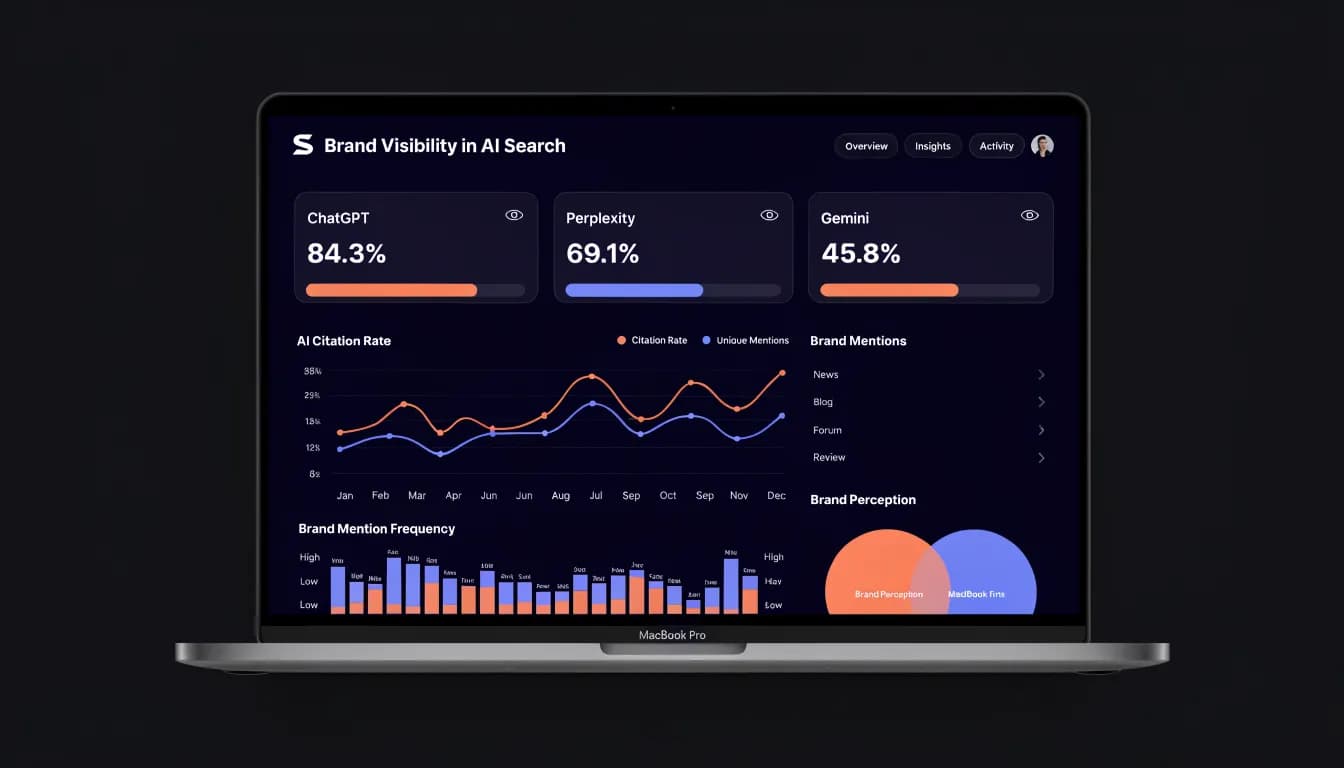
You search "LLM tracking tools" and spend the next 20 minutes reading about API latency, trace spans, and token cost monitoring. That's not what you were looking for. You want to know if ChatGPT recommends your brand when a prospect asks for the best tool in your category — and that's an entirely different product category from what most of those results cover. The same phrase covers two completely separate problems: one for developers debugging AI apps, one for marketers tracking brand visibility in AI responses. Most roundups don't make that distinction — so you end up with a list of engineering tools and no way to know if your brand is even showing up. Do you know your AI visibility score right now? If not, finding the answer means first knowing which half of this market you're actually shopping in.
Your brand is generating a response in AI chatbots right now — either a mention or a silence — and it's happening without you in the room. Ninety-four percent of B2B buyers use generative AI during the purchase process, according to 6sense's 2025 Buyer Experience Report. That means every time a prospect asks ChatGPT "what's the best [your category] tool," a decision is being shaped by data you've never audited. LLM referral traffic grew 527% year-over-year in 2025 (Search Engine Land), and Adobe Digital Insights found that AI-referred visitors convert 31% better than traditional search traffic and drive 254% more revenue per visit. You are not measuring any of this yet. Most marketing teams running solid SEO programs have never checked their LLM visibility score — not because they don't care, but because the tooling landscape is genuinely confusing. Half the "LLM tracking tools" you'll find in SERP results are designed for machine learning engineers who need to debug AI applications. The other half — the seven tools below — are built for teams who need to answer a different question: does the AI recommend us?
The LLM Tracking Trap: Why Half the Tools You'll Find Aren't for You

Before you evaluate any tool, you need to know which problem you are solving.
LLM observability tools (built for developers) answer: Is my AI application performing correctly? They track token costs, API latency, trace spans, hallucination rates, and model drift. Tools like LangSmith, Langfuse, Arize AI, Helicone, Portkey, and Datadog LLM Observability live here. They are excellent at what they do. But they have no concept of "brand mention" or "citation share." The word "brand" doesn't appear in most of their documentation.
LLM tracking tools for marketers (the ones this article covers) answer: Is my brand mentioned when someone asks ChatGPT for a recommendation? They run structured prompt queries across ChatGPT, Perplexity, Gemini, Claude, and other platforms, then report back your share of voice, citation frequency, competitor benchmarking, and sentiment. This is closer to media monitoring than application performance tracking.
The distinction matters because if you buy a developer observability tool expecting brand visibility data, you'll get exactly zero useful marketing insights. The SERP for "llm tracking tools" mixes both categories — confident-ai.com's top-ranked article covers LangSmith, Arize, and Datadog exclusively, none of which will tell you whether Perplexity mentions your product. That's the trap.
Every tool below solves the marketing problem: brand visibility in AI-generated responses. If you need LLM SEO tracking at a deeper technical level, you'll want to explore the broader LLM SEO landscape as well.
1. Allable — Best All-in-One LLM Brand Tracking for Marketing Teams

Price: Free forever | Pro: €31/month (~$33/month) | Business: €91/month (~$98/month)
Allable is built as a unified platform for marketing teams that want to monitor their brand visibility in AI responses without purchasing a standalone point solution. While most LLM tracking tools exist only to monitor AI visibility, Allable combines it with SEO analytics, content strategy, and competitor intelligence in a single workspace — which means your LLM tracking data sits next to your keyword rankings, content performance, and campaign results rather than in a separate tool you need to context-switch into.
For LLM brand tracking specifically, Allable monitors your brand mentions across the major AI platforms — ChatGPT, Perplexity, Gemini, and Claude — and surfaces your visibility score, share of voice against named competitors, and citation source breakdown (which third-party pages are driving your mentions). The platform also connects with Google Search Console to correlate AI referral traffic with traditional organic traffic, giving you a more complete picture of where your search authority is actually coming from.
Who it's for: Marketing teams and SEO specialists who are already using (or would prefer to use) a single platform for SEO + LLM tracking rather than managing separate tools and logins. The pricing model makes it competitive with standalone LLM trackers at the Growth tier, while the Business plan covers the full marketing stack.
What it doesn't do: Allable is not a developer observability platform. If you need trace-level AI app monitoring, LangSmith or Langfuse are the right tools. But for the question "does AI recommend us when someone asks for our category?" — this covers it.
2. Profound — Best for Enterprise AI Citation Intelligence

Price: Starter $99/month (ChatGPT only) | Growth $399/month (multi-engine) | Agency $99/month base + add-ons | Enterprise: custom
Profound is the most-funded dedicated LLM tracking platform in the market right now. Its February 2026 Series C raised $96 million at a $1 billion valuation, with Lightspeed Venture Partners leading alongside Sequoia Capital, Kleiner Perkins, Evantic, and Saga. That investment level signals enterprise-grade seriousness — and the product reflects it.
The platform runs against a 260M+ prompt database and covers ChatGPT, Google AI Overview, Gemini, and Perplexity. You get brand mention frequency, share of voice across prompt categories, competitor benchmarking, citation source attribution, and sentiment scoring. Profound's key strength is depth: it can break your visibility down by prompt intent ("best X for agencies" vs "cheapest X" vs "X vs competitor"), which gives you actionable insight into which buying-stage queries your brand is winning or losing.
Who it's for: Enterprise marketing teams and larger agencies where LLM visibility is a dedicated program with budget to match. If you're managing a brand that's in active AI-generated purchase consideration (B2B SaaS, financial services, professional services), and you need the most detailed citation intelligence available, Profound is the benchmark.
What it doesn't do: The Starter plan only covers ChatGPT — you'll need the $399/month Growth plan for multi-engine tracking. There's no free tier. Budget-constrained teams may find the entry point steep for a dedicated tool. For a full look at what Profound offers relative to alternatives, see our Profound alternatives analysis.
3. SE Ranking — Best for SEO Teams That Want LLM Monitoring Included

Price: From ~$55/month (annual) / ~$65/month (monthly) — LLM tracking included in standard plans
SE Ranking started as a traditional SEO platform and added LLM brand monitoring as a core feature in 2025. For teams that already use SE Ranking for keyword tracking, rank monitoring, and competitor analysis, the LLM visibility module is an included addition rather than a separate purchase — which makes the effective cost of LLM tracking essentially zero if SE Ranking is already in your stack.
The LLM monitoring module tracks your brand mentions across the major AI platforms, gives you a visibility score, and compares your performance against competitor mentions on the same query set. It's less granular than Profound's prompt-category breakdowns, but it covers the basics: "Are we being mentioned? How often? Relative to who?" That's the minimum viable data set for most mid-market marketing teams.
One caveat worth noting: SE Ranking published their own "10 Best LLM Tracking Tools" roundup and ranked themselves #1. Draw your own conclusions about objectivity there — but the product itself is independently confirmed by multiple third-party reviews.
Who it's for: Teams already using SE Ranking who want to add AI visibility monitoring without purchasing a separate tool. Also a strong choice for budget-conscious teams that need solid LLM tracking without Profound's enterprise pricing.
What it doesn't do: SE Ranking's LLM module isn't as deep as Profound on citation source attribution or prompt-intent breakdowns. If you need to understand why you're being mentioned (or not), you may outgrow it.
4. Peec AI — Best for Real-Time Brand Monitoring Across AI Platforms

Price: From ~$49/month
Peec AI launched in 2025 and raised a €21 million Series A following an initial €5.2 million seed round — making it the fastest-funded pure-play LLM brand tracker in the European market. The platform's core strength is real-time monitoring: rather than scheduled batch queries, Peec AI aims to surface brand mentions as they occur across AI platforms.
The tool covers ChatGPT, Perplexity, Gemini, and Claude, and tracks mention frequency, sentiment, share of voice, and competitor comparisons. The interface is built for marketing teams rather than engineers — no configuration required beyond entering your brand name and competitor set. For teams that want immediate visibility into how a PR campaign, product launch, or content push affects their AI mentions, the real-time focus is a differentiated value.
Who it's for: Marketing teams and agencies that run active brand campaigns and want to measure their AI visibility impact in closer to real time. Also a reasonable entry point for teams new to LLM tracking — the pricing is accessible and the setup is straightforward.
What it doesn't do: Peec AI is a dedicated brand monitor, not a full marketing platform. You'll need separate tools for keyword research, content strategy, and SEO analytics. The platform is also relatively young, which means enterprise-grade integrations and historical data depth are still developing.
5. Nightwatch — Best for Agencies Combining Rank Tracking and LLM Visibility

Price: From $32/month
Nightwatch is primarily known as a rank tracking and SEO reporting tool for agencies, and its LLM monitoring feature extends that positioning rather than replacing it. If you manage multiple client accounts and want a single platform that handles traditional rank tracking, SERP monitoring, and AI visibility in one place, Nightwatch covers that combination at a price point that makes per-client economics work for agencies.
The LLM monitoring component tracks brand mentions across AI platforms and provides visibility data for reporting. It's not as feature-rich as Profound or Peec AI on the AI-specific side, but for agencies that already have Nightwatch in their stack (or are choosing between rank-tracking tools), the integrated LLM visibility is a meaningful differentiator over alternatives that don't include it.
Who it's for: SEO agencies managing multiple client accounts who want consolidated reporting that includes AI visibility data. Also a practical choice for in-house SEO teams that want rank tracking as their primary function and LLM monitoring as a secondary capability.
What it doesn't do: Nightwatch's LLM monitoring is complementary rather than leading-edge. If AI visibility is your primary use case (rather than an addition to rank tracking), Profound or Peec AI will offer more depth.
6. ZipTie.Dev — Best for Technical Teams That Need Both Developer and Marketing Data

Price: Not publicly listed — verify directly at ziptie.dev before budgeting
ZipTie.Dev occupies an unusual position in this market: it's the most developer-friendly tool on the marketer-facing list. If your organization has engineering resources that need LLM tracing data AND a marketing team that wants brand visibility reports, ZipTie builds a bridge between those two use cases.
The platform provides standard LLM brand tracking (brand mentions, share of voice, competitor benchmarking) alongside more technical data about how your content is being cited in AI responses. For companies building AI-assisted products who also want to understand their brand's AI visibility, ZipTie avoids the need to run separate developer observability and marketing monitoring tools.
Who it's for: Technical marketing teams, growth engineering functions, or companies where the same person is responsible for both AI product monitoring and brand visibility. If you're not a developer, ZipTie's UI is still approachable, but its full value requires technical context.
What it doesn't do: ZipTie is not a full SEO or content platform. You'll still need separate tools for keyword research and content strategy. Pricing transparency is also limited — verify current plans directly before budgeting.
7. Scrunch — Best for Enterprise AEO Programs

Price: Enterprise pricing — contact Scrunch directly
Scrunch positions itself at the enterprise end of the Answer Engine Optimization (AEO) market. Rather than just tracking whether your brand is mentioned, Scrunch focuses on understanding the structure of AI-generated answers in your category: which sources get cited, how answer formats vary across platforms, and what content structures correlate with citation. This makes it less of a "brand monitor" and more of an "AEO intelligence platform."
For large enterprise marketing teams running structured AEO programs — where the goal is not just monitoring but actively improving AI citation rates — Scrunch offers a level of analytical depth that goes beyond most tools on this list. It was confirmed in Zapier's 2026 AI visibility roundup as a platform to watch in the enterprise segment, though it remains in relatively early commercial availability.
Who it's for: Enterprise marketing teams with dedicated AEO programs, significant content operations, and the budget for a premium analytics layer. Scrunch makes most sense as a complement to your AEO tools rather than a standalone tracker.
What it doesn't do: Scrunch is not the right choice for teams just starting LLM tracking — it assumes you're already running an active AEO program. Pricing and availability are not publicly listed, which makes it harder to evaluate on a standard software budget cycle.
Feature Comparison Table: LLM Tracking Tools for Marketing Teams
Tool | Starting Price | Platforms Tracked | Free Tier | Best For |
|---|---|---|---|---|
Allable | Free / Pro €31/mo | ChatGPT, Perplexity, Gemini, Claude | Yes | Marketing teams wanting SEO + LLM in one platform |
Profound | $99/mo (ChatGPT only) / $399/mo multi | ChatGPT, Google AI, Gemini, Perplexity | No | Enterprise AI citation intelligence |
SE Ranking | ~$55/mo | Multiple AI platforms | No (trial available) | SEO teams wanting LLM tracking included |
Peec AI | ~$49/mo | ChatGPT, Perplexity, Gemini, Claude | No | Real-time brand monitoring |
Nightwatch | $32/mo | Multiple AI platforms | No | Agencies combining rank tracking + LLM |
ZipTie.Dev | Verify at site | Multiple AI platforms | Check site | Technical teams needing dev + marketing data |
Scrunch | Enterprise pricing | Multiple AI platforms | No | Enterprise AEO programs |
How to Evaluate an LLM Tracking Tool Before You Buy

Most LLM tracking tools are less than 18 months old. That means pricing is volatile, features ship fast, and "best" from a January 2026 review may not reflect the current product. Before you commit to a paid plan, apply this four-question framework.
1. Which AI platforms does it actually track?
Don't assume multi-platform coverage. ChatGPT and Perplexity have only an 11% domain overlap in what they cite (GrowByData, 2026) — being visible in one does not guarantee visibility in the other. If you're in B2B, Perplexity and ChatGPT are your highest-priority platforms. Verify explicitly before purchasing a plan.
2. Does it track brand mentions OR citation sources?
Some tools only confirm that your brand was named. Better tools also tell you which pages caused the mention — which third-party review, Reddit thread, or press article drove the AI to cite you. 85% of AI brand mentions come from third-party pages, not your own site (AirOps, 2026). If you can't see citation sources, you can't improve your mentions.
3. Can you track competitor share of voice?
Your LLM visibility score only makes sense relative to your competitive set. A tool that shows your brand was mentioned in 12% of relevant prompts sounds different when your main competitor is mentioned in 34% of the same prompts. Verify that competitor benchmarking is included, not an add-on.
4. What does the prompt library look like?
The best tools run structured prompts across query categories: "best X," "cheapest X," "X for [industry]," "X vs competitor." A tool that only runs generic brand name searches will miss the intent-specific visibility gaps that actually matter. Ask vendors directly: how many prompts run per week, how are they constructed, and can you customize them?
If you're still comparing your options with traditional AI SEO tools, it's worth understanding where LLM tracking sits in a broader AI search visibility stack before committing to a standalone tool.
What Good LLM Tracking Data Looks Like in Practice
Most teams that set up LLM tracking for the first time find the first few weeks disorienting — the data looks different from anything in their existing analytics stack. Here's what you should expect to see in a working weekly LLM tracking setup.
Your AI Visibility Score (AVS): The core metric is simple: prompts where your brand is mentioned ÷ total prompts run, expressed as a percentage, per platform. Your baseline in week one is your starting point. What matters is the week-over-week delta.
Share of voice vs. your top three competitors: Pick the three competitors most likely to appear alongside your brand in AI recommendations. Track their AVS on the same prompt set. This tells you whether a change in your score reflects a market-wide shift or a movement specific to your brand.
Citation source breakdown: Which third-party pages are driving your AI mentions? You're looking for review articles, category roundups, community discussions (Reddit, LinkedIn), and press coverage. This list is your AEO action backlog — the pages worth building relationships with or replicating.
Platform-by-platform spread: Don't aggregate across platforms. Run separate tracking for ChatGPT, Perplexity, Gemini, and Claude. They have dramatically different citation patterns — your ChatGPT visibility and your Perplexity visibility are two different signals that require different responses.
Prompt-category performance: Which intent clusters is your brand visible in? "Best X" prompts trigger brand mentions at 69.71% vs near-zero for other prompt types (2026 research analysis). If your brand only appears in "what is X" prompts but never in "best X" or "X for agencies" prompts, that's a specific gap, not a general visibility problem.
One practical note: 44.2% of LLM citations come from the first 30% of a page's content (SparkToro, January 2026). If your brand description on third-party pages is buried in the fifth paragraph, you're losing citation potential that front-loading would recover.
This kind of structured AI visibility program is what the emerging field of AEO tools is built around — LLM tracking is the measurement layer; AEO strategy is what you do with the data.
Other Notable Tools Worth Knowing
The seven tools above are the primary options for marketing teams, but the broader LLM tracking market is expanding fast. The AEO software category on G2 grew more than 2,000% in a single year (2025–2026). A few additional platforms that may be relevant depending on your setup:
Semrush AI Visibility Toolkit ($99/month per domain): If your team is already on Semrush, the AI toolkit is the path of least resistance. It covers brand mention tracking in AI responses and integrates with Semrush's broader competitive intelligence features. Purpose-built alternatives like Profound go deeper, but the Semrush option removes one more login.
Ahrefs Brand Radar ($199/month add-on): Ahrefs' approach focuses on benchmarking your brand's AI mentions against industry competitors over time. The $199/month add-on pricing makes it a meaningful additional cost, but for teams already using Ahrefs for backlink analysis and keyword research, it extends a familiar workflow.
Gumshoe.AI: Takes a persona-based approach to LLM tracking — you define buyer personas rather than prompts, and the tool models what those personas would ask AI chatbots. Interesting differentiation, but less established than the primary tools above.
Otterly AI: A more accessible entry point to AI visibility monitoring, positioned for small teams and solo practitioners. Worth checking if budget constraints rule out Profound or Peec AI.
Frequently Asked Questions
- What is LLM monitoring?
- LLM monitoring means two different things depending on who's asking. For developers, LLM monitoring is the practice of tracking AI application performance — token costs, output quality, latency, and hallucination rates. Tools like LangSmith, Langfuse, and Arize AI serve this use case. For marketers, LLM monitoring means tracking whether your brand is mentioned in AI-generated responses — when customers ask ChatGPT or Perplexity for product recommendations, does your company appear? Tools like Profound, Peec AI, and Allable serve this second use case. Both are called "LLM monitoring" in different contexts, which is why the search results for the term are so confusing.
- What is the difference between LLM monitoring and LLM observability?
- LLM observability is a developer-focused practice: it involves capturing detailed traces of AI application behavior, including span-level data on prompts, outputs, latency, and evaluation scores. It answers "is my AI app working correctly?" LLM monitoring in the marketing sense answers a different question: "is my brand visible in AI-generated answers?" The two concepts overlap in name only. If you're a marketer looking to measure whether ChatGPT recommends your product, you want a brand visibility tool — not an observability platform.
- How do you track brand mentions in ChatGPT?
- Dedicated LLM tracking tools like Profound, Peec AI, Allable, and SE Ranking do this automatically: they run structured prompts across ChatGPT (and other platforms), detect when your brand is named in the response, and report back your mention frequency, share of voice, and citation sources. The manual version — asking ChatGPT yourself — doesn't scale and produces inconsistent results because ChatGPT responses vary per session, geography, and model version. A tracking tool runs standardized prompts at regular intervals, giving you comparable data over time.
- What is the best LLM tracking tool for marketers in 2026?
- It depends on your situation. Profound is the most powerful dedicated option for enterprise teams with budget to match. Peec AI is the best pure-play choice for real-time monitoring at a more accessible price. SE Ranking and Nightwatch are strong options if you want LLM tracking bundled with a broader SEO platform. Allable is the best option if you want LLM brand tracking as part of a full AI marketing platform (SEO, content, campaigns, competitive intelligence) without purchasing separate tools.
- How do you measure AI visibility?
- AI visibility is measured through a metric called AI Visibility Score (AVS): the percentage of relevant prompts in which your brand is mentioned. A working measurement setup runs a structured prompt set across ChatGPT, Perplexity, Gemini, and Claude — covering prompts like "best [your category] tool," "best [your category] for agencies," and "[your category] vs [competitor]" — and calculates your mention rate per platform. Tracking this weekly against your competitor set gives you a baseline and a trend. The SEO vs AEO comparison is a useful starting point if you're deciding how to allocate attention between traditional search and AI search visibility.
- Why can't I just use Google Analytics to track AI visibility?
- Google Analytics records sessions that originate from known referral sources. AI chatbots like ChatGPT and Claude do not reliably pass referral data in the standard way — conversations that generate a click to your site often appear as "direct" traffic or under a generic AI referrer. That means GA significantly undercounts the actual influence of AI on your traffic. Dedicated LLM tracking tools solve this by measuring visibility at the source (in the AI response itself) rather than trying to infer it from downstream click patterns. Forrester estimates AI-generated traffic is currently 2–6% of B2B organic traffic and growing at 40%+ month-over-month — the portion your GA is capturing is a fraction of that.
Track Your Brand Visibility in AI Search
Allable monitors your brand across ChatGPT, Perplexity, Gemini, and Claude — so you know when AI recommends you, and when it doesn't. Free to start.