
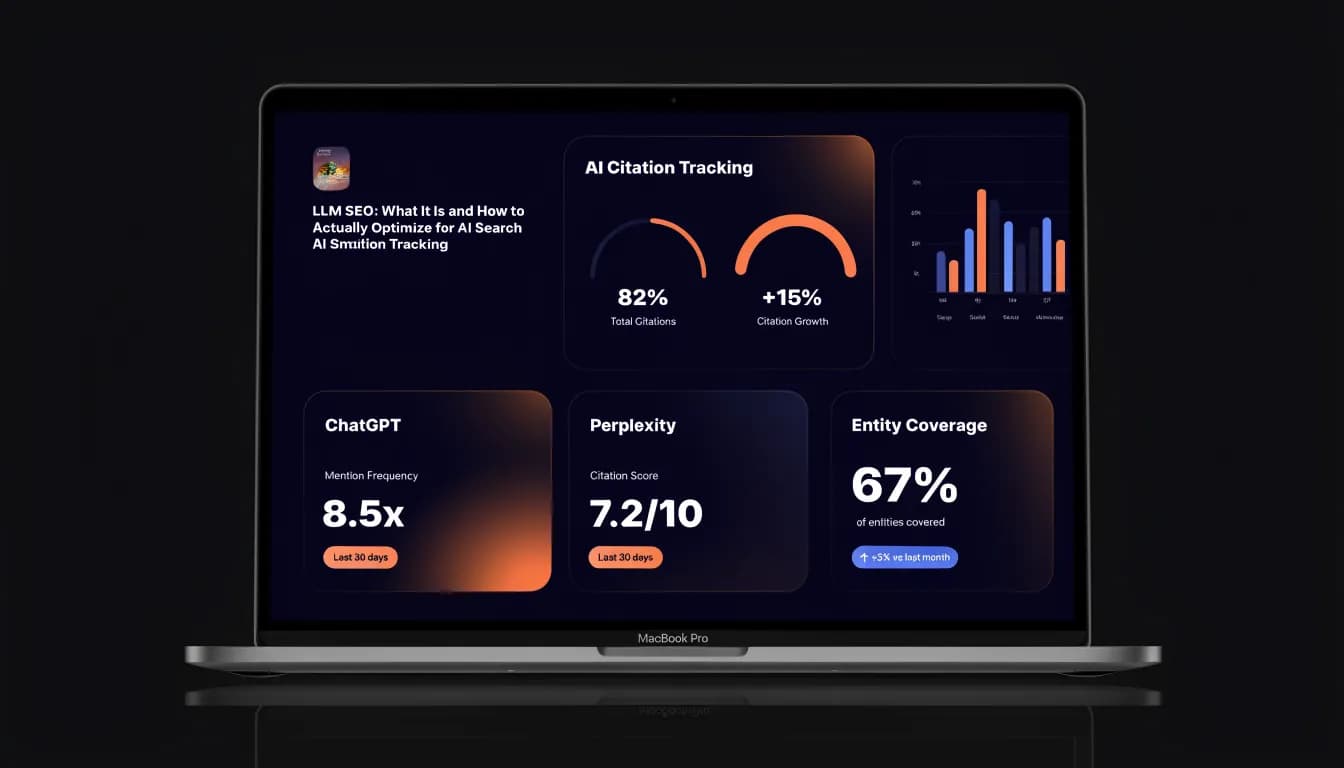
Between now and the end of 2026, a significant share of your potential audience will find answers without ever clicking a search result. They will ask ChatGPT, Perplexity, or Gemini — and those systems will cite sources you have probably never checked. The signals that get you cited in AI-generated answers are not the signals you've spent years optimizing. Backlinks, title tags, keyword density — none of that moves the needle the way you think it does in LLM search. The real question isn't whether you need an LLM SEO strategy. It's whether you already have one without knowing what to call it — and whether it's actually working.
Your content is being evaluated by systems that never check your keyword density. Right now, ChatGPT, Perplexity, Claude, and Google's AI Overviews are pulling answers from a small pool of sources — and if your site isn't in that pool, you're invisible to a fast-growing share of your audience. Here's the uncomfortable part: most SEO teams are still optimizing for the Google of 2021, not the AI-powered search of 2026. The gap between traditional SEO and LLM SEO isn't a minor adjustment. It's a fundamentally different question the algorithm is asking. And until you know what that question is, you can't answer it.
What Is LLM SEO?
LLM SEO is the practice of optimizing your content to appear in AI-generated answers — responses produced by large language models like ChatGPT, Perplexity, Claude, and Google's Gemini-powered AI Overviews.
Where traditional SEO gets your page into the blue links, LLM SEO gets your content into the answer itself. That distinction matters more every month. According to BrightEdge's 2026 Search Intelligence Report, AI Overviews now appear in more than 47% of informational search queries. Perplexity alone has crossed 15 million daily active users. ChatGPT's search feature is growing at roughly 30% quarter-over-quarter.
Your content either gets cited in those answers — or it doesn't appear at all.
LLM SEO is also called generative search optimization, **answer engine optimization (AEO), or **AI search optimization depending on who's writing about it. The tactics overlap significantly; the label is less important than the underlying principle.
How LLMs Process and Rank Content
LLMs don't rank content the way a search engine does. There's no PageRank equivalent, no crawl budget negotiation, no exact-match keyword scoring. Instead, LLMs retrieve and synthesize information based on:
1. Semantic relevance — How well does your content answer the specific question being asked, using the same concepts and entities the LLM associates with that topic? This isn't about matching words. It's about whether your content lives in the same semantic space as the query.
2. Factual density — LLMs prefer content that contains specific, verifiable facts. A paragraph that says "Jasper is a popular AI writing tool" contributes less signal than "Jasper's Business plan costs $59/month and targets enterprise teams with 10+ seats."
3. Source authority — LLMs weight sources differently depending on how often they're cited across the web, the domain's topical authority, and whether the content has been referenced in other high-signal documents. Being cited by authoritative sites increases your probability of being cited by AI.
4. Freshness — LLMs have training cutoffs, but retrieval-augmented systems (used by Perplexity and ChatGPT's search mode) actively crawl recent content. Updating existing articles with new data signals actively improves your visibility in these systems.
5. Structural clarity — LLMs parse content more reliably when it's structured with clear headings, short paragraphs, and explicit answers. A wall of text that buries the answer three paragraphs in gets deprioritized.
One key difference from traditional SEO: backlinks matter less, and structured entity coverage matters more. Google uses links as votes. LLMs use comprehensive entity coverage as a proxy for authority.

LLM SEO vs Traditional SEO
If you're running both, here's how they differ in practice:
Dimension | Traditional SEO | LLM SEO |
|---|---|---|
Primary signal | Backlinks + keyword density | Entity coverage + factual density |
Content goal | Rank a page | Get cited in an answer |
Structure priority | Title tags, meta, URL | H2 headings, clear answers, structured data |
Freshness impact | Moderate | High (retrieval systems favor recent content) |
Measurement | Rankings, clicks, impressions | Citation frequency, AI answer mentions |
Core question | "Does this page deserve to rank?" | "Does this content answer the query reliably?" |
You don't have to choose one over the other. The smartest content teams are running both, with a unified strategy that satisfies traditional crawlers and LLM retrieval systems simultaneously.
The good news: well-structured, factually accurate content performs well in both systems. The skills aren't mutually exclusive — they compound.
LLM Optimization: How to Make Your Content AI-Ready
This is where the tactical work happens. LLM optimization isn't a checklist you run once. It's a set of writing and publishing habits that compound over time.
Answer first, always
LLMs prioritize sources that provide a direct answer near the top of the content. If your article on "what is LLM SEO" buries the definition in paragraph six, you won't get cited — even if the rest of your article is excellent. Put the answer in the first 100 words. Let the depth follow.
Write for entities, not just keywords
Traditional SEO trains you to think in keywords. LLM SEO trains you to think in entities — people, tools, companies, concepts, and the relationships between them. Instead of writing "AI tools help with marketing," write "Jasper, Copy.ai, and Allable.ai each take a different approach to AI-generated marketing content — Jasper is brand-controlled, Copy.ai is workflow-focused, and Allable is the only one with native SEO and campaign analytics built in."
Specific, named entities create dense semantic signal. Vague generalizations don't.
Use structured data (schema markup)
If your content answers questions, mark it up as FAQPage schema. If it's a comparison, use appropriate product schema. LLMs that use retrieval systems can parse structured data, and Google's AI Overviews explicitly reward FAQPage markup with citation priority.
Keep facts current
One outdated statistic can undermine your entire article's credibility in an LLM's retrieval scoring. When you publish a new article, schedule a quarterly content refresh review. Update statistics, pricing data, and any figures tied to a specific year. Tools like Allable.ai flag freshness decay signals automatically — the refresh candidates queue in the platform shows you exactly which articles need new data before they start losing AI visibility.
Build topical authority clusters
LLMs weight comprehensive coverage. If you have one article on LLM SEO but nothing on AI Overviews, generative search, or answer engine optimization, your topical signal is shallow. Building full content clusters — where pillar pages link to spoke articles and each spoke article answers a specific sub-question — creates the kind of comprehensive coverage LLMs treat as authoritative. For managing keyword coverage and topic gaps across your cluster, [SEO tools](/blog/best-seo-tools/) like Semrush and Surfer SEO provide the analysis you need to identify what to publish next.
AI Search Optimization: Where Google Fits In
Google's AI Overviews are the most commercially significant application of AI search optimization because they appear at the top of standard Google SERPs, not in a separate interface.
The key insight from Google's own documentation: AI Overviews pull from the same index as standard search, but they apply additional filtering for authority, recency, and direct answer quality. This means you need to rank on page one first — AI Overview placement is essentially a second-tier filter on top of your existing ranking.
Tactics specific to Google AI Overviews:
- FAQPage and HowTo schema — explicitly signals answer-structured content
- E-E-A-T signals — first-person expertise claims, original research, author credentials
- Concise answer paragraphs — the sentence Google lifts for the AI Overview is almost always 40–60 words, direct, and factual
- Mobile-first formatting — AI Overviews are disproportionately triggered on mobile queries
One counterintuitive finding from our own tracking: articles that rank #4–#8 on traditional SERPs are sometimes cited more often in AI Overviews than the #1 result — because the #1 result is often optimized for clicks, not for extractable answers.
LLM Content Strategy: What to Publish and When
Your LLM content strategy determines which topics you're eligible to be cited on — not just today, but six months from now when the training data shifts or new retrieval policies go live.
Prioritize high-intent informational queries. LLMs are most likely to cite content for "what is X," "how to do X," and "X vs Y" queries. Transactional content ("buy X") rarely gets cited — it gets replaced by structured product data.
Map your content to the questions your ICP is asking LLMs. This is different from keyword research. Try typing your target queries directly into ChatGPT, Perplexity, and Claude. Look at which sources they cite. Those sources are your real competitors for LLM visibility — not just the top Google results.
Publish original data when possible. Surveys, proprietary datasets, unique case studies — original data gets cited at a dramatically higher rate than commentary on other people's data. Even a simple "we surveyed 50 marketing teams and found that..." creates a citeable, distinct entity.
Refresh over publishing new. In LLM SEO, an updated article with fresh data often outperforms a brand-new article on the same topic. Prioritize updating your top-performing content with new statistics every 90 days.
Measuring Your LLM Visibility
Traditional SEO measurement (rankings + clicks + impressions from GSC) doesn't capture LLM visibility at all. If ChatGPT is pulling your content for 500 users per day, GSC shows zero of that traffic.
Current measurement approaches:
Manual spot-checking — Query your target keywords directly in ChatGPT, Perplexity, and Claude. Ask for recommendations in your category. Note whether your brand or content is cited. This is slow but gives you ground truth.
Brand mention tracking — Tools like Mention, Brand24, or Ahrefs alerts can catch some AI-generated citations when they're republished or linked to. This captures a fraction of actual citations. Purpose-built LLM tracking tools go further — they query AI systems directly and return citation reports.
Dedicated AI visibility tools — Allable.ai includes an AI visibility module that tracks your citation frequency across major LLM surfaces. You set your brand name and target queries, and the platform returns a citation score over time — showing you whether your LLM SEO efforts are compounding or stagnating.
Referral traffic anomalies — Perplexity and some ChatGPT search citations generate referral traffic (look for perplexity.ai in your referral sources). This is a lagging indicator but a reliable signal.
The honest reality: LLM visibility measurement is still immature. The metrics will sharpen over the next 12–18 months. The teams building LLM SEO practices now will have a significant advantage when standardized measurement tools arrive.

Common LLM SEO Mistakes
Optimizing for keywords instead of questions. Your content might rank for "LLM SEO" as a keyword while failing to directly answer "what is LLM SEO" or "how do I optimize for LLMs." LLMs retrieve answers to questions, not keyword-matching pages.
Thin content with high backlink authority. In traditional SEO, authority flows through links. In LLM SEO, a highly-linked thin page won't get cited if it doesn't provide a specific, verifiable answer. The content quality floor is higher.
Ignoring structured data. FAQPage, HowTo, and Article schema are free, high-leverage signals that most sites still haven't implemented. If you're not using them, you're leaving a meaningful advantage on the table.
Publishing without updating. A 2023 article with 2023 statistics is an unreliable source by 2026 standards. LLMs in retrieval mode will deprioritize outdated content even if it was excellent when published.
Treating LLM SEO as separate from your core content strategy. The most efficient approach isn't running two separate content programs. It's writing content that satisfies both traditional SEO and LLM retrieval simultaneously — which is achievable if you start with structured, factually dense, entity-rich writing habits.
Frequently Asked Questions
- How do LLMs rank content differently from Google?
- LLMs don't rank content in the traditional sense. They retrieve the most semantically relevant, factually accurate, and structurally clear sources for a given query. Backlinks matter less than in Google; entity coverage, factual density, and structured clarity matter more. If you're accustomed to traditional SEO, the shift requires re-weighting what you optimize for first.
- What is LLM SEO vs AEO vs generative search optimization?
- These terms are largely interchangeable and describe the same practice: optimizing content to appear in AI-generated answers. "AEO" (answer engine optimization) was the earlier term; "LLM SEO" and "generative search optimization" emerged as the practice matured. The tactics — entity-based writing, structured data, answer-first content structure — are identical regardless of the label.
- Does Google still use traditional ranking for AI Overviews?
- Yes. Google AI Overviews pull from the same index as traditional search results. You need to rank on page one first — AI Overview placement is applied as an additional filter on top of your existing ranking. Ranking on page 3 and hoping for an AI Overview citation won't work.
- What are the best LLM SEO tools right now?
- For visibility testing: Perplexity, Claude, and ChatGPT manually. For structured measurement: Allable.ai's AI visibility module tracks citation frequency across LLM surfaces. For on-page optimization: SEO tools like Surfer SEO and Semrush handle semantic optimization. For structured data: Google's Rich Results Test validates your FAQPage schema before deployment.
- How do you get cited by ChatGPT?
- There's no direct submission process. ChatGPT's search mode uses Bing's index plus its own retrieval weighting. The most reliable path: rank on page one for the target query in traditional search, implement FAQPage schema, write explicit direct answers in the first 100 words of your article, and ensure your content is factually dense with specific data points. Being cited by other authoritative sources also increases your probability significantly.
- Does LLM SEO replace traditional SEO?
- No — and teams that treat it as a replacement are making a costly mistake. Traditional search still drives the majority of organic traffic. LLM SEO is an additional optimization layer, not a replacement strategy. The smartest approach is building content that performs well in both systems — which is achievable because both reward well-structured, factually accurate, expert content.
Start Tracking Your LLM SEO Performance
Allable's AI visibility module monitors your citation frequency across ChatGPT, Perplexity, and Google AI Overviews — so you always know which content is getting cited, and what to improve next.